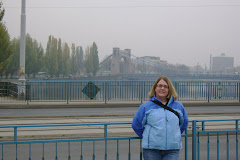
Thursday, August 9, 2007

Sudetenland, Part II

Today's Czech Minute!
One of the comforting things about spending time ensconced in another culture is that you have many opportunities to discover how very similar all members of the human race are. Case in point: while visiting Broumov for my on-site lessons about the Sudetenland, we had lunch at a pub frequented by working-class men of the town. Martin commented that he looks for workingmen at pubs at lunchtime to know that the food is good. While having our lunch, I couldn't help but notice that the workmen of the Broumov area looked and acted an awful lot like workmen in Oregon: farmer tans, frequent olging and cat-calling of young, attractive women, and unfortunate displays of butt crack. Ah, it's just like home . . .


My introduction to Broumov (Bro-mov) began with a survey of the large and stately homes on the street leading to the main square. Martin noted that many successful entrepreneurs from the 19th and early 20th Century had made their money in the region and built their homes in this street, I assume as a way to showcase their wealth. (People are the same all over.) At the peak of Broumov's prominence, there were more than 10,000 people living in the town (which is fairly good-sized for a Czech village) and quite a few wealthy and prominent citizens, many of whom probably had German surnames. These homes are in various physical states now, but Martin told me that very few of them are currently being used as single-family residences. Most or all have been converted into schools/retirement homes/flats/businesses, etc. Broumov no longer has the thriving economy that it once did.

Our first official stop in Broumov was at the Benedictine Monastery. Because Prague served for a while as the capital of the Holy Roman Empire (Charles IV, crowned King of Bohemia in 1346, was also crowned Holy Roman Emperor in 1355), many monasteries were built throughout what is now the Czech Republic, and Catholicism in general was central to Czech life for a long time. Interestingly though, the Czech Republic, and specifically Bohemia, now has one of the highest rates of athiesm in Europe (Moravia, on the other hand, still has a very active Catholic population). It's a complicated issue, naturally, but this shift was partially due to the fragmentation that happened as a result of the Protestant Reformation, and partially due to the influence of the Communist regime. The monastery in Broumov, for instance, served as a "concentration camp" of sorts for monks and nuns during the Communist era. Following the fall of the Soviet bloc, a handful of monks attempted to rebuild the monastic community there but eventually moved to Canada, so the monastery is now empty and cared for as a historic site. I'm not Catholic, but even I found it disconcerting to be taken into areas of the chapel and monastery where only priests could have gone before. It felt very disrespectful or sacreligious. Martin reminded me that Czech people, to a great degree, have lost faith in this sort of religious reverence, and asked if I didn't think that, ultimately, any space is just space, since any importance of it only exists in our minds?

Randomly, while we were in the sacristy of the chapel (one of the rooms in which I felt very uncomfortable), the tour guide drew our attention to a fresco on the ceiling which was blackened all around the sides but had clearly been cleaned in the center. She said the entire painting had not been cleaned to show the build up of soot from years of candle and incense burning. She then told us that their budget is quite small and they were unable to afford professional restoration services, so one of the curators tried gently cleaning the fresco with bread--apparently, it worked like a charm. Also, a copy of the Shroud of Turin was found inside an altar in one of the cathedral chapels in 1998. No one is exactly sure how long it had been there, but it seems likely it was hidden purposefully, perhaps to be saved from destruction during the Communist era.

Here is a not-particularly-stellar photograph of the Monastery. As a side note about it, like most monasteries around the world, it had a "real work" focus to allow the monks to make enough money to live on, and as with many monasteries in Europe, this one made beer . . .


From the monastery, we moved further into town, to the oldest church in Broumov, the Church of Saint Mary. It also happens to be the oldest stick-built church in Central Europe, dating from the early part of the 13th Century. Miraculously, it only burned once, in 1459, when Hussites set fire to it, and was rebuilt shortly thereafter. It was not open, unfortunately, but the front door had an opening through which the interior could be viewed. The window was covered with wire mesh rather than glass so what I remember most, even weeks later, is the smell of the interior--the mixture of decay and mildew and dust is hard to describe, but it's that smell that just proclaims that something is old. It was very disappointing to not be able to go sit inside for a moment, but it's obvious--commendably so--why it's not open for public access. There are services held inside on high holy days, however, so maybe I can go back for Easter mass.


Part of the reason for visiting the Church of Saint Mary was to see the cemetery in the church yard. You can read the history of the town in the gravestones, most of which look like this (note the names):


Following the Second World War, there was some destruction done to graves in this cemetery, so there are hundreds of headstones that now lean against the wall of the church yard, some damaged and some not:


The newest graves in the cemetery bear stones written in Czech, and almost always bearing Czech or otherwise Slavic names. I'm not sure I would have noticed it consciously, had I not been told about the repatriation of Germans after the war, but it certainly shows in the cemetary that all things German vanished from Broumov after 1945.

After we had lunch in town (with the workmen), we drove out to Martin's parents' chalet. Many, many Czech families keep cottages or country houses that they use on weekends. In the summer, Martin's parents live at the chalet from Friday to Monday every week. Here, we rested for a bit (with beer, naturally) and watched the kids swim before continuing our tour. For the second half, Hanka and the girls stayed at the chalet while Martin and I drove further out in the country to tour some abandoned churches. Martin explained that there are ten churches in the Broumov area that constitute what is known as the Broumov Circle. All of the churches were designed by German architects Christoph and Kilian Dientzenhofer (brothers) between about 1710 and 1730, and were architectural marvels when constructed as the Dientzenhofers' designs bucked many of the prevailing trends for religious spaces at the time. I had already seen one of the churches (the small chapel on the ridge at Hvezda) and Martin thought we could get to 4 or 5 more pretty easily. Our first stop would be in Sonov (Sho-nov) to see the Church of Saint Margaret (Marketa, in Czech). With this church, the Dientenhofer design tried to take full advantage of the small rise upon which the church would be built, to try to make the building seem as organic as possible. As we drove from Broumov to Sonov, in a rural area with lots of orchards and corn fields, the church was the only visible building, partially hidden by trees. (I should have made Martin stop the car for a photo, but I didn't. Here is one photo I took as we climbed up the hill, though . . .)


Once we reached the top of the hill, it was much more apparent how much the condition of the church has deteriorated since its abandonment by a local congregation. Martin thought we might be able to get in, as it isn't always securely closed, but it was on this day. (I later learned that concerts are held in the church quite often, so I will update this post with interior photos after I attend a concert!)


We stood there looking at it for quite a while, and Martin finally asked me what I was thinking, saying he was very curious what I thought about something like this. I said that it made me sad--it's a beautiful building, and was meant to be a place of community and worship, and it's been left to sink back into the ground it seems like--and I wondered why no one was trying to save it. I don't know if Martin and I always completely understand each other--while his English is very good, I know he doesn't always understand all the words that I use, and I think he must be limited sometimes in communicating with me because he doesn't know all of the words he wants to use. That being said, he sort of paused after my reply and said, "Do you think we should save everything?" Later, I think I realized what he meant--this is a nation where buildings from the 14th and 15th Century are routinely being used for homes and businesses in every city. Maybe a church, that is arguably pretty ostentatious for a small village like Sonov, shouldn't be a top priority? As we walked back down the hill, I remember thinking that Martin didn't have any sense of sentimentality. Now I think maybe he was just being pragmatic.

We were about to climb into the car when I asked if we could wander through the church yard that was just across the road. It contained a much smaller church, and the local cemetary.


While we were wandering through the cemetary, reading stones (all of which bore Czech names and seemed to be recent--Martin said later that he guessed the townspeople had destroyed the old German ones, noting that that kind of thing probably didn't happen in more religious communities), Martin struck up a conversation with an older man who was tending some graves. We were particularly interested in two graves that were marked with large headstones bearing the names of two priests and seemed very well-cared for (and of which, of course, I didn't take a photo). The man told the following story (to Martin, who translated it for me): the two priests, as evidenced from the names on the headstones, were German and several people in the town believed that they had been Nazi collaborators during the war. One night, sometime after the war was over, a group of men drinking in a pub convinced themselves that they should murder the priests for collaborating and set out in a lynch mob of sorts. They broke into the rectory in the middle of the night, and dragged the priests out of bed and up into the nearby hills, where they were made to dig their own graves before being shot and buried there. In 1992, a group of citizens from Sonov decided to find the graves, which they did, and dig up the remains of the priests to re-inter them honorably in the cemetary, and have arranged for care of the graves ever since. I suppose you could say this was an act of contrition. The man said he was a young boy when it happened, but he remembered it being spoke of in days following. He also said that any evidence of actual collaborating by the priests was anecdotal and not very reliable, seeming to suggest that they probably weren't collaborators at all.

On the way out of Sonov, Martin pointed out a stone pillar on the side of the road and said that these markers are all over the Czech Republic and indicate important historical events. I asked what the one we had just seen was for and he said he didn't know--there are no plaques or signs to indicate the reason for a marker; instead you have to ask locals to find someone who knows. I asked about the problem of inaccuracy--what if people tell the wrong story? Martin looked at me and simply asked, "Why would they do that?"

I started to get the feeling that I wasn't going to be able to find out any of the things I wanted to know about the Czech Republic from books.

By the time we left Sonov, we were already late for dinner at the chalet so we only stopped at two more churches that were on our way. The first was a Protestant church whose tower seemed to dominate the skyline as we drove back into Broumov. Ironically, Martin said he had never been to it so we should stop to take a look. It is not part of the Broumov circle, however, but still kind of impressive in its own right.


The second was another Dientzenhofer church of the Broumov circle, in slightly more dilapadated shape than the Church of Saint Margaret, complete with its own overgrown cemetery, seen here:


Just across the road from this church is a relatively new artist colony, that has become controversial in conservative Broumov (and that I also forgot to take a photo of). It is inhabited, sporadically, by artists from Prague who are looking to return Broumov to its former prominence and glory, only this time due to its art scene. Some citizens find it offensive, some find it silly, and some are just curious if it will ever happen. Apparently, the artists have been coming to the area for about 10 years and nothing very spectacular has happened YET. Europeans are much more patient when it comes to change and the effects of time, having a much longer view of history themselves, so it's probably way too early to predict what will happen with this venture.

And, next door to the church, is a building that has recently been purchased by a wealthy man from somewhere else (probably Prague) and he is converting it into his home. The building was the old, original pub and stable in Broumov. I asked Martin if he was bothered by the man making his home out of this historic site, but he seemed much more annoyed by the outside money than anything the man was doing with the building.

By this point, we were really late for dinner. Luckily, Mr. Vancl was just starting the barbeque fire when we arrived. Dinner was the largest platter of sausages I have ever seen (where eating "only" 2, as I did, was barely considered a meal) and lots of fresh vegetables from the garden, and, of course, more beer. After dinner, the beer turned to Slivovice (plum brandy) and Becherovka (some sort of spicy liquer that is allegedly good for digestion). Czechs don't use mixers, and beer doesn't really count as alcohol, so when you really start drinking, that means shots of whatever is at hand. I also had the distinct pleasure of trying some sort of pressed pork loaf, that mostly seemed like bits of pork in lard, which is a Czech delicacy, eaten drizzled with vinegar. I'm sorry to say that it was not good, even with all the alcohol I had imbibed.

It was well past sunset when we finally left the cottage. The girls were spending the weekend with their grandparents so Hanka & Martin could do some work on their house, but they needed some tiles first so I was invited for a shopping trip to Hradec Kralove on Saturday, which seemed much safer than spending any more time near Martin's father and his liquor cabinet.

Wednesday, August 8, 2007

Settling into Hronov

Today's Czech Minute!
This country must have the highest rate of lung cancer on the planet because EVERYONE here smokes, with the possible exception of Martin and Hanka. It's survivable because all pubs and restaurants have outdoor patios, which is where we always sit. How I will survive this in winter, I have no idea . . . .

In the interest of getting through some of the events and experiences in a more efficient manner (and due to the fact that I don't have any photos to accompany this post), today's entry will simply consist of a list of things I had experienced by the end of the day on August 8:

1. My first power outage in the Czech Republic, which actually happened at about 9pm on my first night in the apartment. Um, is this normal? Not really, as it turned out. Super! What a welcome wagon!

2. The heaviest rain storm I have ever seen in my life (and no, I'm not exaggerating). This is the kind of rain where in running 30 feet from a car to a building, a person ends up LITERALLY soaking wet, as Martin was when he arrived to accompany me to my first play at the Jiraskovu Theater Festival in Hronov. Said rainstorm was accompanied by thunder and lightning so loud there were times we could not hear the actors inside the theatre.

3. My first theatre performance, of a play called EQUUS. Something about a boy who wants to be a horse and a psychiatrist who hates his wife? What can I say, my Czech is really not that good.

4. My first trip to the post office, where I learned that you can not only take care of postal issues, but pay your utility bill and buy cleaning products. I don't know why.

5. My first use of my door bell! I live in one of those buildings like you always see in movies about New York where people can ring your flat from the outside door and you have to push a button to open the door for them? Yeah, turns out those little systems don't so much come with instructions. Luckily the rain hadn't started and Martin didn't have to wait THAT long for me to figure it out.

6. My first train ride, in this case to Nachod to visit Martin's house. 14Kc for 9 kilometers, and the rate gets better the farther you travel. I think the train we took had a total of 2 cars. Awww, it's kind of cute!

7. My first visit to a single-family home in the Czech Republic, which is beautiful. Martin is a construction guy when he's not teaching so he's done almost all of the renovations on their home himself, complete with an entire kitchen from IKEA! The visit began with an incredibly kind and generous moment, where Martin showed me his front door and said, "It is always open for you--anytime you need us, you are welcome here." I teared up (and did again as I recounted the moment here).

8. My first cross-cultural history discussion, with maps spread out across the table and everything. After some very good beer from Nachod (Primator), Martin and I continued our conversation about the Sudetenland and the relationship between the Germans and the Czechs. More on this in the next post about my visit to Broumov.

9. My first agreement for the exchange of language lessons, made with Martin's wife, Hanka. We have discovered however that the only way either of us are actually going to be able to learn language from each other is to have our lessons away from Martin. (It's just so much EASIER to have him translate!)

10. My first deep realization that I have a lot to learn about the presence of the Roma (Gypsy) population in Central Europe. When Hanka drove me home after our lovely evening of dinner and conversation, she pointed out a building that is, apparently, inhabited by Roma of the area, repeating the same criticisms and stereotypes(?) I had heard from Kamila and Martin, almost to a word. I am completely uninformed on this particular issue, but it sure sounds like racism to my American ears.

Sudetenland, Part I

Today's Czech Minute!
As I think is well-known, Europeans, in general, have a much less Puritanical attitude towards the human body and nudity. One of the things that this means is that it is not at all unusual to see women walking around in a bra--not a sports bra, but a regular satin-and-lace kind of bra. I have seen women doing yardwork in bras, and also crossed paths with a woman on our hike at Hvezda who had gotten warm, apparently, and stripped down to her bra on the trail.

Speaking of Hvezda, my second day, or perhaps first real day, in Hronov, turned out to be very long, in the best way. If it was in any way a harbinger of the year I would have in the Czech Republic, I could only look forward anxiously the rest of the lessons I would learn.

Martin, accompanied by his family, picked me up in his 1987 red hatchback Skoda (pronounced Shkoda--it is the one and only automobile brand produced in the Czech Republic) for a trip to a place called Hvezda. He said something about a church named Star or something, but truthfully I really had no idea where we were going or what we were going to do. I was just thrilled to be in the company of other people, and Martin was quickly becoming someone I liked very much. Martin's lovely wife, Hanka (the Czech version of Hannah), generously climbed into the very small backseat, in between the two car seats no less, so that I could sit up front and talk with Martin about the day's "program", as he is always calling it. Our travels, again if you are following along on your handy map of the CR, was north just a few kilometers from Hronov, towards a low ridge of mountains where we would make a "short walk" (again, Martin's words--I have since come to understand what this means in his mind--let's just say we do not speak the same language, in more ways than one). As we began our walk, Martin also suggested I be on the lookout for mushrooms, as we were in a good spot to find them. (In my head, I was thinking, "WHAT?!?!" but I just nodded. I would later learn that mushroom hunting is, perhaps, the favorite activity of Czech people in the summer and early fall. Who knew?)

(Here are the other members of the Vancl family, as we started our hike, er, "short walk" at Hvezda. Hanka is flanked by her daughters: Annicka on the left, is 5, and Emma, on the right, is 2.)


We reached the chapel on the top of the hill really quickly, which was a huge relief to this rather fat, lazy, and out of shape American. It seemed like a very strange place for a small church, but Martin said it was still used for worship services occasionally. However, from the viewpoint next to the church, you could look down into a valley, still misty in the late morning, and see villages tucked between fields in seemingly blissful, pastoral fashion.

(A couple not-very-good photos of the view from the Hvezda viewpoint, but hopefully you get the idea.)


One of the villages Martin pointed out to me as a place called Broumov (now, in Czech), but that had once been Braunau (it's German equivalent). He commented that while it looks quite picturesque from a distance, it is actually quite damaged. When I asked for an explanation about this, the Czech Republic, and specifically the region I am currently living in, started to come into focus. The ridge we were standing on, in 1938, was assigned as the border of the Sudetenland, so the land and villages we looked out upon had been in the territory ceded to Germany in the Munich Pact. These borders were determined, as I understand it, largely because of the great numbers of German descendents who lived in this area, having settled it on the invitation of a Czech king in the 12th or 13th century. As the history buffs among us know, the central part of Hitler's grand plan was to create a great German empire, which required the German populations of other nations to be reunited with their "motherland", so the acquisition of these lands in Czechoslovakia moved him toward his goal. As far as day-to-day life for people in these regions of the Sudetenland, though, the Munich Pact really had no impact. But then the war ended. In 1945, as part of an attempt to weaken the German state, the victors decided that all German people needed to be repatriated to Germany--they feared that a pocket of Germanic people outside of Germany could incite German nationalism such that there could be another war, and this had to be prevented at all costs. Nevermind that these "Germans" hadn't lived in Germany in more than 700 years, and nevermind that a now-devastated Germany was in no position to support an influx of several hundred thousand people. The people who carve up maps in well-appointed palaces rarely bother with the details, it seems, thus thousands of homes throughout the Sudetenland were left abandoned, only to be seized later by Czechs eager for free property. In Martin's mind (and this is a theory or interpretation I have heard from a few others as well), the people who moved into the abandoned homes did not exhibit the same level of commitment and work ethic that the previous owners had because they had not had to sacrifice to obtain the property. As a result, the communities have deteriorated, both in physical condition and prominence. Broumov, for instance, has less than a third of the population now that it had in the years just before the war. Martin also noted that the Roma population in Broumov, and other areas of the former Sudetenland, is now much higher than in other parts of the Czech Republic.

While my head was still sort of spinning as I wondered what had happened to all of these people, Martin announced that it was time to continue our walk. (I knew the first part was too good to be true . . . ) Luckily, the trail wasn't too bad, but it did involve a lot more climbing and scrambling over boulders than I anticipated. It was worth it for the view though, which you can see here:


We also climbed to another viewpoint, where you could see into the valley again. Martin was able to point out some of the buildings--churches, a monastery--in Broumov, and suggested that we make a visit there the next day. I was definitely intrigued, and I think Martin appreciated that I was interested, so the outing was settled and we began our descent. After the hike down, it was definitely time for lunch. So, we stopped a hotel/restaurace on the road toward Hronov that Martin & Hanka like because it has a play area for kids, which wasn't its only special feature.

(Here is the hotel/restaurace.)


The restaurant was not only kid-friendly, it was dog-friendly, as you can see from this sign:


(Translation: "DOG BAR. Self-service." HAF is the sound that dogs make in Czech, like "woof" in English.)

After a busy and interesting morning, I returned to the apartment for a short rest before attending my first play at the theatre festival. Martin had agreed to accompany me, and then bring me to his house for dinner. I looked forward to an equally busy and interesting afternoon and evening.

Tuesday, August 7, 2007

I arrive in Hronov . . . to the sounds of Dixieland Jazz?

Today's Czech Minute!

Women in the Czech Republic consider a much wider range of colors when dyeing their hair. In younger women, true burgundy and a sort of reddish orange color are very popular, and among older women, pastels are VERY popular: lavender, pink, light green, etc. These colors could be applied on the entire head, or in streaks that approximate "highlights" in the U.S. The vast majority of the hair color I have seen, and the way in which it has been applied, makes me think I am not getting my hair colored while I am here. I saw one woman on the street today who had great highlights and wanted desperately to ask her where she gets her hair done but thought it might seem odd . . .

Moving on . . . some people have already heard the rather traumatic story of my arrival in Hronov, but I will recount it here nevertheless. Following our departure from lovely Podebrady, something went very wrong with Mr. Mach's transmission. The first plan was to stop in a town called Hradec Kralove (Hra-detz Kra-low-va) where he would go to a repair shop and Kamila and I would continue our journey via bus. However, he could not find the repair shop and was afraid to stop the car so we kept going, arriving in Hronov after all. Kamila has a friend with an auto repair shop in Hronov so she was going to take Mr. Mach there to have the car evaluated. Thus, I was dropped off fairly quickly (although Mr. Mach, at nearly 70, insisted on carrying both of my gargantuan suitcases up to the fourth floor), which made me cry, both out of fear and loneliness, and my conviction that I was a jackass because not only had I kicked Mr. Mach out of his house for three days AND had him miss a day of work to drive to Hronov and back, but I had also been the cause of his car breaking down. I could only imagine how happy he was to have met this "Americanka" (pronounced Amer-ee-chanka). I was also waiting for my mentor teacher, Martin Vancl, to meet me at the apartment and wasn't sure how long it would be before he arrived. Luckily, it wasn't more than ten minutes. This was good for the loneliness part, but bad for the part where I was still crying. Have I mentioned that the Czechs aren't so much emotive? So, I knew I was making a REALLY good first impression on Martin as well. Super! I was really off to a stellar beginning in Hronov.

Initially, Martin and I got off to a bit of a rocky start. I think he was hesitant--completely understandably--about just what he had gotten himself into in agreeing to be my mentor for the year, and I made a couple of self-deprecating jokes that he clearly wasn't sure how to interpret. (I was really batting 1000 here.) BUT, the good news is that it took less than an hour for us to be on very good terms. I think the turning point was when he commented, "You are always joking," and I responded, "Well, when I'm not crying, yes," which made him laugh. At that point, I was pretty sure we were going to be fine.

Martin's first task, as assigned by my exchange partner Honza, was to orient me to the theatre festival that was well underway in Hronov. Honza & Marketa had arranged tickets for me to three shows, with the option of getting more, so Martin took me for a walk so that I could learn where the theatres were located. He pointed out that there were daily concerts in the park, one of which was just about to start, and would I like to see if it was interesting? Sure. "We could have a beer," he said. Oh, then abso-@#$%-lutely. That was the best idea I had heard all day. The band playing was from Hronov, and were just setting up as we approached, where Martin bought me my first beer in Hronov for 14 kc (about 75 cents). It was a group of men, all in their 60's & 70's probably, and as they warmed up, what should greet my ears but totally Louis Armstrong-influenced, big-brass jazz. I'm pretty sure I laughed. I had flown across the Atlantic and half of the European continent, driven on successively smaller roads to arrive in a small town just a few kilometers from the Polish border, and walked from there into a park that was barely differentiated from the forest around it to hear American music? What were the odds?

(Here is the band--unassuming in appearance, but they sounded pretty good.)


Oh, but it got better . . .

After a couple of songs that varied from Dixieland to Big Band, a male singer was introduced and began a song I was sure I recognized. Wait . . . what IS it? Oh my god, it's "My Way" with Czech lyrics. I turned to Martin and said, "Oh my god, it's Frank Sinatra!" He looked at me and clearly had no idea what I was talking about.

K: Frank Sinatra--you know who he is, yes? This is his signature song!
M: Oh. Oh, yes. But not in Czech.

Well, you got me there, Martin.

(Here is Frank Sinatra's Czech version.)


But again, it got better . . .

A few more songs later, a young woman came out who was also going to sing. Martin translated her introduction, to tell me to get excited because she was going to sing in English. Awesome! Her first song was "Sentimental Journey". Being the mean and catty American woman I am, I had a very hard time stifling the laugh that I knew was absolutely inappropriate. While I'm fairly certain she was singing the English lyrics, they were almost entirely unintelligible, largely due to pronouncing English words using the Czech alphabet, which I assure you causes very different results. Her next song was "I'm Beginning to See the Light" which was, well, equally entertaining for me. (I need to add that she had a very sexual stage presence, and was heavy on the sort of gravely vocalizations that I associate with the stereotypical "torch singer" here, which only heightened the comic effect as it was 4 o'clock in the afternoon. As a side note, try explaining what "torch singer" means to non-native speaker sometime.)

(Here is an unfortunately disappointing photo of the torch singer . . . I hope your imagination can fill in the details for the full effect.)


And yet again, it got better . . .

I was sorry to see her leave the stage, but leave she did. The band played some more songs. The male singer returned for a few songs. And then, yes, she came back. She was going to finish her set with Billy Joel's classic, "Just the Way You Are." I knew this was going to be good, but she actually exceeded my expectations. (Perhaps it's only fair to mention that I was most of the way through my second beer by this point, and still very much working on acquiring a European tolerance for alcohol.) How did she exceed expectations, you ask? Because in addition to her inappropriately sexual presense for a park concert in broad daylight and her rather funny pronunciation of English words, she also knew less than half of the actual lyrics to the song. One verse, in her version, went something like this:

I said forever and that's forever
You don't know how much to say
So now I love you even more
I love you just the way you are

AWESOME. Excellent, excellent performance.

Following the concert, Martin walked me back to the apartment, having presented a full schedule of events for the next day. Meanwhile, I was beginning to think that life in Hronov wasn't going to be so bad after all.

Podebrady

Today's Czech Minute!
The Czechs clearly do not have the paranoid fear of pedophiles that Americans do because it is very common to see young children running around naked in public parks/fountains/etc.

I mention this fact because I first noticed it when we were in Podebrady, and have seen it several other places since, but I digress.

On Tuesday, Kamila and I got up and cleaned Mr. Mach's apartment as a small token of thanks since he had slept in his shop for three days while we stayed in his apartment in the city. He arrived at the apartment at about 9:45 to load us up for the drive from Prague to Hronov, which I was told would take about 2 hours. Kamila had her one tiny suitcase, and I had my two enormous ones, so we were quite the group trudging down to the parking garage!

It took quite a long time to leave the metro area of Prague--our route (if you're keeping track on your handy map of the Czech Republic) was basically due east to Hradec Kralove, and then sort of north-east to Hronov. Not too far out of Prague, we came into this exquisitely beautiful town, and I began looking around like mad for signs so that I could write it down as a place to come back to for further exploration. To my delight, as we came through the main square, Mr. Mach pulled into a parking lot and I learned we were stopping to explore a little and have lunch--thus I encountered Podebrady!

The main square in Podebrady, featuring a heroic statue of a lesser-known Czech king who was born here.


Podebrady is a Czech spa town, highly frequented due to it's not-too-terrible tasting mineral water and it's relative nearness to Prague. It is quite popular with Germans and Russians, I am told. There are many famous spa towns in the Czech Republic (Karlovy Vary/Karlsbad being the most famous), and apparently it is a completely usual thing for a doctor to "prescribe" three weeks at a spa. Unlike at an American spa which largely involves pampering, three weeks at a Czech spa would entail drinking a great deal of the local mineral water, soaking in said water, and engaging in vigorous exercise. (Martin's wife, Hanka, is spending the upcoming weekend in Podebrady and plans to rollerblade, and do dance and step aerobics, among other things--this is a "spa weekend" in the CR.) However, even if you are not in town on doctor's orders, you can still partake of the mineral water, which of course we all did.

This is where you can get a glass (or many glasses, if you like!) of the Podebrady mineral water. As you can tell from the foggy photo, it's kind of humid in there!


And here are Mr. Mach and Kamila, feeling healthier already, having drunk their respective shares of the magical water.


The fountains/faucets for the water are located in the middle of a large and beautifully landscaped park, the centerpiece of which is this fountain, where, you will notice, there were no naked children at the time we took the photo.


Mr. Mach took a rest on a bench while Kamila and I walked around the park. Afterwards, it was time for lunch! Still unable to read a Czech menu with any kind of reliability, I chose something for the name and got lucky--I had a great lunch of grilled chicken cooked with peaches, pineapple, and some other kind of fruit. Not exactly a traditional Czech meal, but still really, really good. The portion was huge, and I had yet to fully comprehend that this was due to the fact that lunch is the biggest meal of the day in this culture. ("Ohhhhhhhhhhh." I would say later.) The little restaurant we ate at, which Kamila remembered from her visit ten years earlier, was very cute, and also quite typical of every restaurant I've eaten at since:


Lastly, Mr. Mach insisted that we get ice cream ("zmrzlina" in Czech--GREAT word). I had read somewhere that Czechs really enjoy their dairy products, but they bring ice cream appreciation to a new level. This is the only country I have ever visited where people come out of an ice cream parlor, cones in hand, at 8:45 in the morning. The ice cream we got in Podebrady was new to me, however. I am used to soft-serve machines that might swirl vanilla and chocolate, but a swirl of apple and caramel? This I had to try, so we all had it! Mr. Mach being Mr. Mach, did we get smalls? No! Did we get larges? No! We had to get the "extra special" which was two levels above large. Here, Kamila enjoys hers:


And so, full of Podebrady "vota" (the Czech word for water--do you see how this blog has become educational as well? You don't even have to feel guilty for wasting time at work to look at it!) and zmrzlina, we continued our journey to Hronov. More on that later.